
Quick Answer
Most Atlanta homes need septic pumping every 3 to 4 years, shorter than the national 5 year average because of our clay soil. Tank size, household size, and garbage disposal use all shorten or stretch that window.
If it has been more than 5 years since your last pumping, or you are seeing slow drains and yard odor, call us today before it turns into a drainfield repair.
We get this question on almost every call. “When was the last time anyone pumped this tank?” The answer is usually “we don’t know” or “when we bought the house.” Septic tank pumping in Atlanta starts at $575. Getting on a schedule is the cheapest way to protect your septic system in Atlanta. Skip it, and the drainfield pays the price.
How often does the average Atlanta household need septic pumping?
Most Atlanta households should pump every 3 to 4 years. That is shorter than the national average of 5 years. The reason comes down to our soil.
The EPA standard for a family of 4 is every 3 to 5 years. We tell our clients in Atlanta to plan for the lower end of that range. Red clay soil in Gwinnett County and Forsyth County drains slower than sandy soil. A drainfield that gets hit with solids overflow has less time to recover here.
We have pumped tanks in Lilburn that had not been touched in 9 years. The owner had no idea. By the time we got there, sludge had backed into the outlet pipe. The drainfield was already taking on solids it should never see. That is the kind of call that turns a $575 pumping into a drainfield repair in Atlanta costing thousands.
Not sure when your tank was last pumped? Call us now.
We serve Lilburn and all of Gwinnett County. We can usually get out the same day.
Does tank size affect how often I need to pump in Georgia?
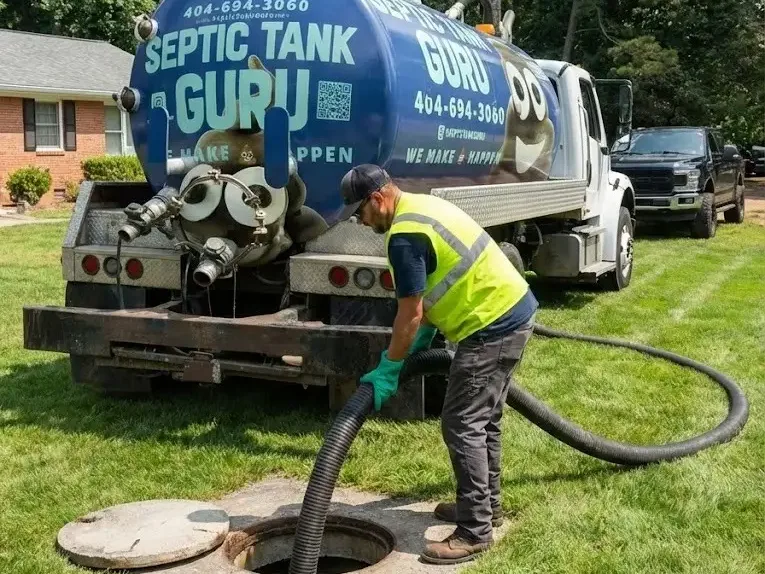
Yes. A bigger tank holds more before it needs pumping, but it does not change the math forever.
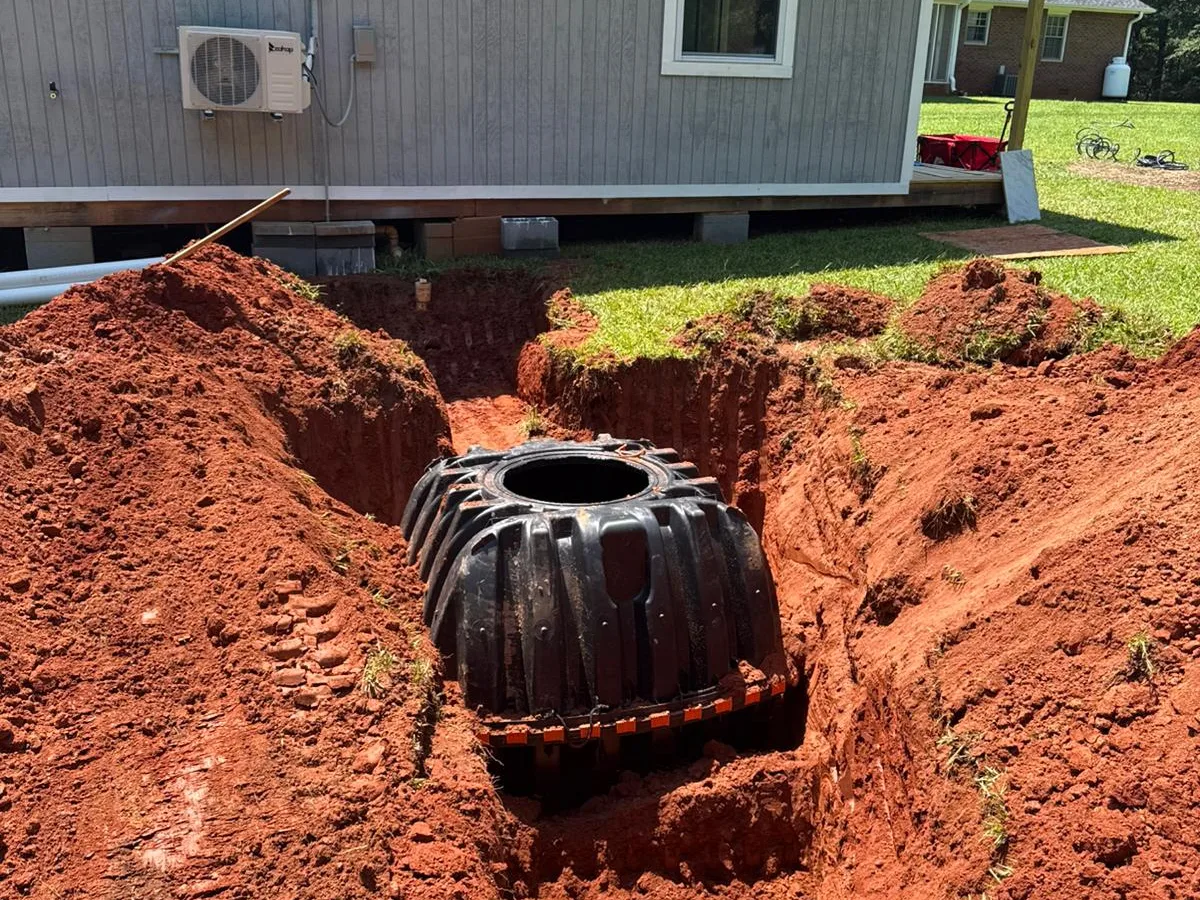
Most Atlanta homes built since the 1980s have a 1,000 to 1,500 gallon tank. A family of 4 uses roughly 400 gallons of water a day through the septic system. A 1,000 gallon tank gives that household less buffer than a 1,500 gallon tank. The smaller tank usually needs pumping closer to the 3 year mark.
Older homes in DeKalb County and parts of Cobb County sometimes still have 750 gallon tanks installed back in the 1960s and 1970s. Those systems were designed for 2 to 3 people using far less water than today’s households. If your home has grown from 2 people to 5 since that tank went in, you are overdue for a size conversation, not just a pumping schedule.
Adding one person to a household cuts the time between pumpings by 20 to 25 percent. A family that grows from 3 to 4 people should expect to move their pumping schedule up by roughly 6 months to a year.
What happens if I skip septic pumping for too long?
The tank fills with solids until they have nowhere left to go but into the drainfield. Once that happens, you are no longer looking at a pumping bill.
Waiting past the 5 year mark without pumping doubles the risk of drainfield damage from solids overflow. A drainfield lasts 20 to 30 years with proper maintenance. Solids intrusion can knock 10 or more years off that lifespan in a single bad year.
We see this pattern constantly in Marietta and Smyrna, where a lot of the housing stock is from the 1970s and 1980s. The original tanks were never replaced. A small repair left unaddressed for 30 days typically doubles in cost. What starts as a $575 pumping becomes a $1,800 to $5,500 major tank repair, or worse, a $1,500 to $4,000 partial drainfield repair.
If your drains have already started backing up or gurgling, that is past the wait and see stage. Our septic tank repair in Atlanta team can assess the damage and tell you honestly whether pumping alone will fix it.
This is fixable. Call us today.
We serve Marietta, Smyrna, and all of Cobb County. Same-day service is usually available.
Does using a garbage disposal mean I need to pump more often?
Yes, and it is one of the biggest factors we see in Atlanta homes. A garbage disposal increases the solids load in your tank by 40 to 50 percent.
That extra solid waste does not break down the way liquid waste does. It sits at the bottom of the tank and builds up faster than the bacteria can process it. A household that would normally go 4 years between pumpings might need to come down to every 2 to 3 years if they run a disposal daily.
We get a lot of calls from Sandy Springs homeowners who renovated their kitchen and added a disposal. They never adjusted their pumping schedule. Two years later they are dealing with a slow kitchen drain and a tank that is fuller than it should be for its age.
If you use a disposal regularly, treat your pumping schedule like it is on a faster clock. Our septic tank pumping in Atlanta team can check your sludge level at the same visit and tell you exactly where you stand.
How do I know when my septic tank is full and needs pumping?
The clearest sign is slow drains in more than one fixture at the same time. If your kitchen sink, bathtub, and toilet are all draining slower than usual, the tank is likely near full.
Other signs include gurgling sounds from drains, a sewage smell near the tank lids or in the yard, and standing water over the drainfield area. Any one of these on its own could be something else. All of them together usually point to a tank that needs pumping now, not next month.
A standard septic inspection in Atlanta starts at $475 and takes 2 to 4 hours. During that visit, we check sludge and scum levels directly. If scum sits within 6 inches of the outlet baffle, it is time to pump. The same goes if sludge sits within 12 inches of the bottom of the outlet, no matter how many years it has been.
We see this most often in Atlanta and East Point. Older homes on smaller lots have systems that fill up faster than homeowners expect. If you are noticing any of these signs, do not wait for the calendar. Call before the backup happens.
What is the recommended pumping schedule from Georgia DPH?
Georgia DPH does not set a single fixed number for every home. The on-site sewage management program ties pumping frequency to tank condition, sludge and scum levels, and household water use. That is why an inspection matters as much as a calendar date.
You can read more about Georgia’s on-site sewage rules directly from Georgia DPH On-Site Sewage Management. In practice, most Atlanta households land on a 3 to 4 year cycle once you factor in clay soil, household size, and whether a disposal is in use.
Georgia law also requires a septic inspection as part of most real estate transactions. If you are planning to sell a home in Kennesaw or anywhere else in Cobb County, getting your tank pumped and inspected ahead of listing avoids a surprise during closing. Our septic inspection in Atlanta service often gets bundled with pumping for exactly this reason.
We have seen this before. We can help.
We serve Atlanta, Sandy Springs, East Point, and all of Fulton County. Call now for a same-day quote.
When should I call right away versus schedule for later?
Some signs mean call today. Others can wait a few days for a scheduled visit.
Call today if:
- Sewage is backing up into a tub, shower, or toilet
- You smell sewage inside the house, not just near the tank
- Standing water has appeared over the drainfield with no recent rain
- It has been 5 years or more since your last pumping and you are seeing any drain trouble
Schedule within 1 to 2 days if:
- One drain is slow but the rest are normal
- You noticed a faint odor near the tank lids but nothing inside the house
- You are not sure when your tank was last pumped and want a sludge check
If you are anywhere in Gwinnett, Cobb, DeKalb, or Fulton County and you are not sure which category fits, call us at 404-694-3060. We would rather talk you through it than have you wait until it becomes an emergency septic pumping in Atlanta situation.
Frequently asked questions about how often to pump a septic tank in Atlanta
What is the average cost of septic pumping in Atlanta?
Septic tank pumping in Atlanta starts at $575 for a standard 1,000 to 1,500 gallon tank. The visit takes 1 to 3 hours. If you wait until you have an emergency, like a backup, emergency septic pumping in Atlanta starts at $700.
Can I go longer than 5 years between pumpings if I am careful with water use?
We do not recommend it. Waiting past the 5 year mark doubles the risk of drainfield damage from solids overflow, even in a careful household. In Cobb County and DeKalb County homes with older systems, we see this risk show up even sooner.
Does pumping fix a smell coming from my drains?
Often, yes. A full tank is one of the most common causes of sewage smell near the house. If pumping does not clear the smell, the issue may be a baffle or drainfield problem. We can run a full septic inspection in Atlanta starting at $475 to find out.
How do I find out the size of my septic tank?
Most Atlanta homes built since the 1980s have a 1,000 to 1,500 gallon tank. Older homes in DeKalb County and Cobb County sometimes have smaller 750 gallon tanks. We confirm your tank size during a pumping or inspection visit.
Should I pump my septic tank before or after a big family event?
Before, if you can plan ahead. A houseful of guests for a weekend can push a tank that was already close to full over the edge. We recommend pumping a few weeks before any event that adds 5 or more people to your household water use.
Will my septic company remind me when it is time to pump again?
We do. After every septic tank pumping in Atlanta visit in Gwinnett, Cobb, DeKalb, or Fulton County, we log your tank size and household details. We reach out when your 3 to 4 year window is approaching.
Is septic pumping different from septic cleaning?
Pumping removes liquid and most solids from the tank. A full cleaning also breaks up and removes scum stuck to the tank walls. Most homes only need a full cleaning every other pumping visit. We can tell you which one your tank needs in Atlanta when we arrive.
Which areas do we cover for septic tank pumping?
We cover all of metro Atlanta. For septic tank pumping in Gwinnett County, we serve Lilburn, Snellville, and Lawrenceville. In Cobb County we cover Marietta, Smyrna, and Kennesaw. In Fulton County we serve Sandy Springs, Atlanta, and East Point. We also cover Stone Mountain, Tucker, and Decatur in DeKalb County. Call 404-694-3060 and we can usually schedule same-day or next-day service.
See this at your home? Call us now.
We serve Gwinnett, Cobb, DeKalb, and Fulton County. We can usually get out the same day.