
Quick Answer
A new drainfield installation in metro Atlanta typically costs $5,000 to $15,000 for a standard installation, with the most common projects landing between $8,000 and $12,000 depending on system size, soil conditions, and county permit fees.
If your property sits on red clay soil in Gwinnett, Forsyth, or Cobb County, plan for the higher end of that range. An engineered or mound system on poor-draining soil can push the total above $18,000.
Every drainfield project we go out on starts the same way: we walk the property, look at the soil, check the system size, and then give a number. That number almost always surprises people. Most homeowners expect drainfield installation cost in metro Atlanta to be closer to $3,000 or $4,000 based on what they read online. The national averages on the big home-improvement sites are not wrong for easy soil in the Midwest. They are wrong for Gwinnett County clay in April. We have been doing this work in metro Atlanta for 13 years. The price is different here. This page explains why, and what you can expect to pay for drainfield installation in Atlanta GA.
What is the average cost to install a drainfield in metro Atlanta?
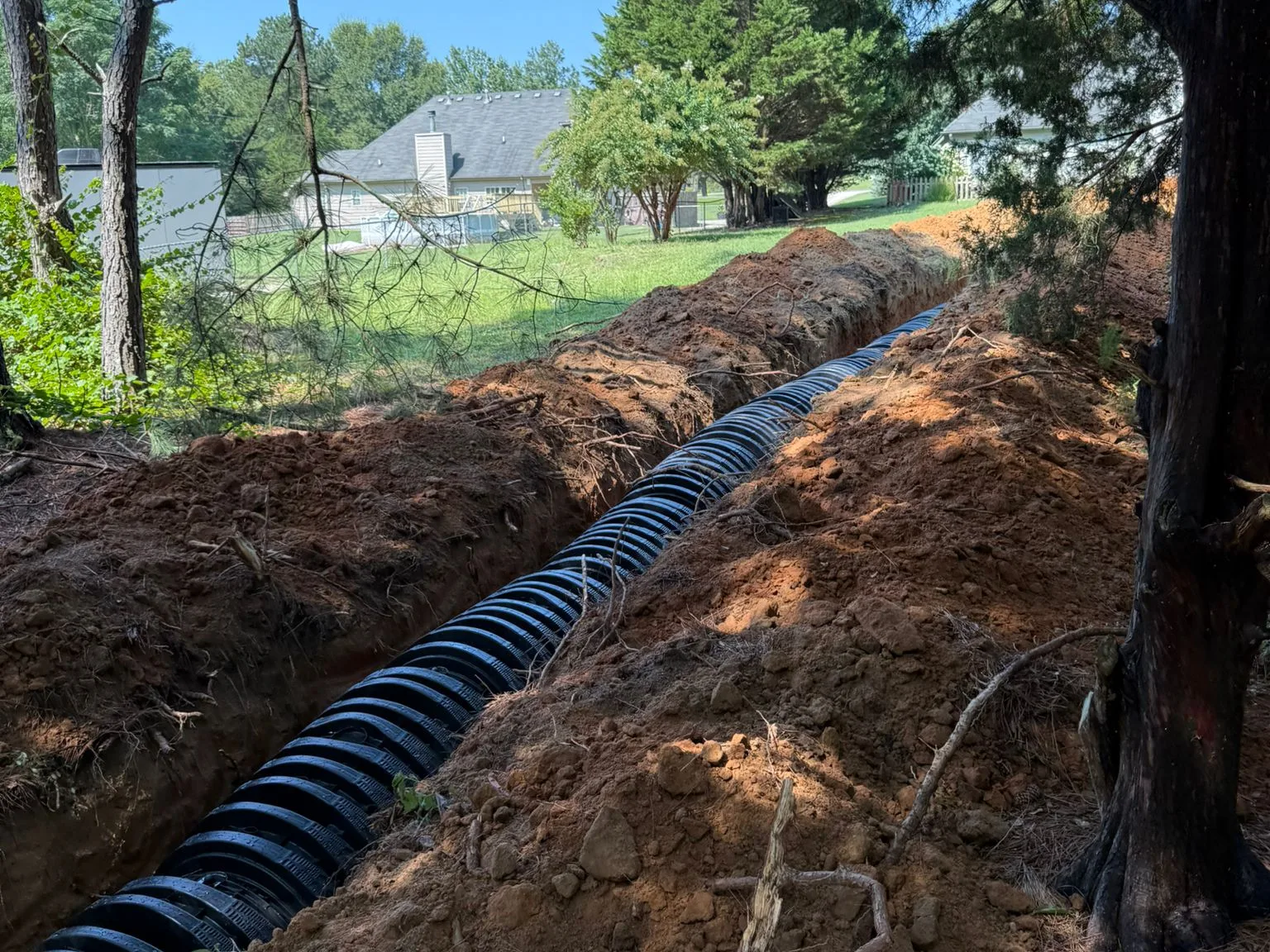
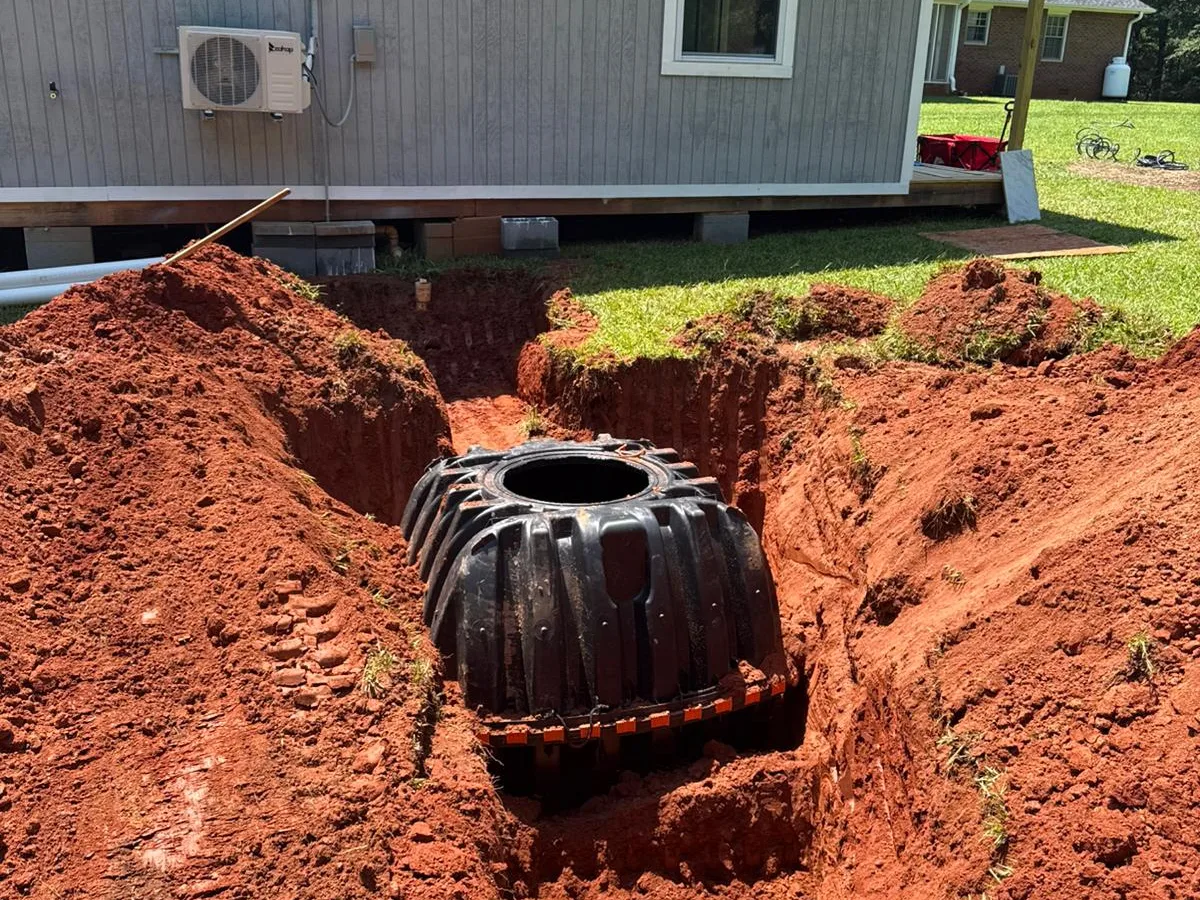
For a standard residential drainfield on a property with decent drainage, the cost in metro Atlanta runs $5,000 to $12,000. That covers excavation, pipe and gravel placement, backfill, and the county inspection. It does not include the perc test or permit fees, which add another $750 to $1,500 on top.
Here is where the number shifts. In Gwinnett, Forsyth, and Cobb County, we are regularly dealing with heavy red clay. Clay does not drain. The county requires larger systems, deeper trenches, or engineered alternatives when the soil does not pass the percolation test. Those jobs run $10,000 to $18,000 for a standard field, and more when an alternative system is needed.
A few weeks ago we quoted a 4-bedroom home in Kennesaw. Standard lot, 1970s construction, original drainfield never replaced. The soil report came back clay-heavy. The 1,250-gallon tank was fine, but the field needed a full replacement. That job landed at $11,500 including permit and inspection. That is a typical number for Cobb County.
For a quick planning reference, here is what we see across metro Atlanta:
| Project type | Typical cost range | Notes |
|---|---|---|
| New drainfield installation (new build) | $5,000 to $12,000 | Good drainage, standard lot |
| Drainfield replacement (existing home) | $6,000 to $15,000 | Varies by soil and access |
| Engineered or mound system | $12,000 to $20,000+ | Required on heavy clay or small lots |
| Permit and soil evaluation fees | $750 to $1,500 | Billed separately from construction |
If you want to understand what drives a repair versus a full replacement, the breakdown of drainfield repair cost across metro Atlanta covers both scenarios side by side.
Need a real number for your property?
We serve Gwinnett, Cobb, Fulton, Forsyth, and all of metro Atlanta. Call us and we can talk through your situation before you schedule anything.
Does clay soil in Georgia make drainfield installation more expensive?
Yes, and in metro Atlanta this is the single biggest cost variable. In Gwinnett and Forsyth County, we are in red clay territory. Clay holds water instead of draining it. A drainfield buried in heavy clay fills up and stops working much sooner than a field in sandy or loamy soil.
When the county soil scientist comes out for the site evaluation, they are measuring how fast water moves through the ground. In clay-heavy areas, the percolation rate is too slow to support a standard gravity drainfield. The county then requires either a larger field, a mound system built up with engineered fill, or an alternative treatment system. All of those options cost more than a basic trench field.
In Gwinnett County, we see this every spring. Homeowners call after a few days of rain and their yard is wet near the tank. The clay was already struggling. Three days of rain finally pushed the system past the edge. We explain the soil situation and what it means for the drainfield installation cost in Atlanta GA before we give any number.
Compare this to Fayette County or parts of Clayton County, where the soil has more sandy loam mixed in. Drainage is better. A standard field has a better chance of passing the perc test. Those jobs more often land in the $5,000 to $9,000 range rather than the $10,000 to $15,000 range you see in clay-heavy north metro counties.
If your property already failed a perc test, read about what your options are after a failed perc test in metro Atlanta. There are still paths forward, but they almost always cost more.
What factors change the price of a new leach field?
Soil type gets the most attention, but there are five other things that move the drainfield installation cost in metro Atlanta up or down.
System size. Georgia calculates system size based on the number of bedrooms in the home. More bedrooms means more daily water use, which means a larger field. A 3-bedroom home needs a smaller field than a 5-bedroom home on the same lot.
Lot access. Drainfield installation requires excavation equipment. If the field location is behind a fence, down a slope, or blocked by trees, getting equipment in takes longer and costs more. We have done jobs in Marietta near the 30066 zip code where the equipment access added $1,500 to $2,000 to the total.
Old system removal. If there is an existing failed field, it has to come out before the new one goes in. Removal adds $1,000 to $2,500 depending on size and how long it has been in the ground.
System type. A conventional gravity drainfield is the least expensive option. A pressure-dosed system costs more because it adds a pump and controller. A mound system or alternative treatment unit can cost two to three times as much as a conventional field because of the engineered fill and additional components required.
Permit timeline. Every drainfield installation in metro Atlanta requires a permit through the Georgia Department of Public Health’s on-site sewage program. Permit processing varies by county. Some counties turn permits around in two weeks. Others take six or more weeks. If your situation is urgent, that wait affects your timeline more than your cost, but it is worth knowing before you start.
The septic system permits guide for metro Atlanta covers permit fees, county contact offices, and typical timelines for all 9 counties we serve.
Is it cheaper to repair a drainfield or replace it completely?
Repair is almost always cheaper in the short run. Partial drainfield repair in metro Atlanta runs $1,500 to $4,000 depending on how many lines are affected. A full replacement runs $6,000 to $15,000. The gap is significant.
The problem is that repair is not always possible. If your drainfield has been saturated for a long time, or if the soil has biomat buildup throughout the entire field, a partial fix just delays the inevitable. We have seen homeowners spend $2,500 on a repair and then call us back six months later for the full replacement anyway.
How do we decide which one to recommend? We look at the age of the field, how long the problem has been going on, and what the inspection shows. If the field is past 20 years old and showing widespread failure signs, replacement is usually the right call. If the failure is isolated to one lateral line on a field that is otherwise in decent shape, repair makes sense.
You can see the full cost breakdown and the repair-versus-replace decision tree in our guide to drainfield repair cost in metro Atlanta. If you have been seeing the warning signs of drainfield trouble, the signs of drainfield failure in metro Atlanta breaks down what each symptom usually means before you start spending money.
One thing we tell every homeowner: a small problem left 30 days typically doubles the cost of the fix. A wet spot that shows up today and gets addressed this week is usually a partial repair. That same wet spot in two months may be a full replacement.
This is fixable. Call us today.
We work in Cobb, Gwinnett, Fulton, and Forsyth County every week. We can usually get out the same day for an assessment.
Does the number of bedrooms affect drainfield size and cost?
Yes. Georgia uses bedroom count as the proxy for daily water use. The Georgia DPH on-site sewage program sets minimum system sizing requirements based on how many bedrooms a home has, because each bedroom represents a certain number of people and gallons per day going through the system.
Here is how it generally works in metro Atlanta:
- 2-bedroom home: smallest allowable field, lowest installation cost
- 3-bedroom home: standard field size, most common project we see
- 4-bedroom home: larger field, may require a second trench line
- 5 or more bedrooms: significantly larger system, higher cost, may push you toward an engineered design
When a homeowner adds a bedroom or converts a bonus room into a bedroom, that officially changes the sizing requirements for the septic system. If the existing field was sized for 3 bedrooms and the home now has 4, the field may be undersized. In Gwinnett County, where we see a lot of 1990s-era homes that have been expanded over the years, this is a common situation. Those homes were permitted for a 3-bedroom system. They are now running 5 people through it and wondering why the drainfield keeps backing up.
A family of 4 uses roughly 400 gallons of water per day through the septic system, according to EPA estimates. Add a fifth person and that number goes up meaningfully. A drainfield that was already borderline will fail faster with that extra load.
If you are buying a home and want to know whether the septic system is sized correctly for the property, a septic inspection in Atlanta GA will tell you exactly what you have and whether it matches the home’s current bedroom count. The cost of a septic inspection in metro Atlanta starts at $475, and it is the only way to know before you close.
What permits do I need to install a drainfield in metro Atlanta?
You need a permit from the county health department before any drainfield installation in Georgia. This is not optional. According to the Georgia Department of Public Health’s on-site sewage management program, all septic installations and replacements must be permitted and inspected by the county.
The permit process works in this order. First, the site evaluation. A licensed soil evaluator comes out and tests how well your soil drains. This costs $200 to $500 and has to happen before anything else. Second, the county reviews the soil report and issues a construction permit. Permit fees in metro Atlanta generally run $250 to $500 depending on the county and project type. Third, once the field is installed, the county inspector comes out for the final inspection and signs off before the system can be covered.
Processing times vary a lot across the nine counties we serve. Cobb County and Fulton County typically run two to four weeks for residential permits. Gwinnett County can take longer during busy spring and summer months when permit volume picks up. If you are in Forsyth County, budget four to six weeks on the permit alone.
Total soft costs including the perc test, permit fee, and design fee (if your soil requires an engineered system) generally add $750 to $1,500 to the installation project. You can find county-specific permit fees in the metro Atlanta septic system permits guide or in our breakdown of perc test costs across metro Atlanta counties.
We pull permits on behalf of our customers as part of the installation process. You do not have to navigate the county health department office yourself. We handle the paperwork and the coordination.
When should I call about drainfield installation right away?
Some situations mean you should call today. Others can wait a few days.
Call today if you see any of these:
- Sewage smell inside the house or strong sewage odor near the tank lid
- Sewage backing up into bathtubs, toilets, or floor drains
- Standing water or sewage pooling on the surface over the drainfield area
- Your yard is wet near the drainfield and it has not rained in several days
Can wait 24 to 48 hours if:
- You have a soggy spot in the yard that appeared after a heavy rain but drains are still working normally
- Drains are slightly slow but nothing is backing up
- You are planning a home addition and want to know if the system needs to be upgraded first
If the drainfield is actively failing, every day matters. A failed drainfield that keeps running sewage through it is getting worse, not better. The warning signs of drainfield failure in metro Atlanta can help you figure out how serious your situation is right now. For homeowners in Sandy Springs or Buckhead dealing with a soggy yard near the 30350 zip code, septic tank repair near Sandy Springs, GA can get us out quickly when the situation is urgent.
If you are buying or selling a home in Fulton County and the drainfield condition is in question, the full breakdown of septic services cost in Fulton County GA gives you the numbers you need for the negotiation.
Frequently asked questions about drainfield installation cost in metro Atlanta
How long does a new drainfield last in metro Atlanta?
A well-maintained drainfield lasts 20 to 30 years in good soil. In the heavy clay of Gwinnett and Forsyth County, we see fields fail in 15 to 20 years because clay holds water and limits recovery time between uses. Regular septic tank pumping in Atlanta GA every 3 to 4 years reduces the solids load on the field and extends its life.
Can I finance a drainfield installation in metro Atlanta?
Some septic companies in metro Atlanta offer financing options. We can discuss payment arrangements when you call. Georgia DPH does not offer direct financing, but some counties have low-income assistance programs for failing septic systems. Call the Cobb or Gwinnett County Environmental Health office directly to ask about local programs.
Does homeowners insurance cover drainfield replacement?
Most standard homeowners insurance policies do not cover drainfield replacement in Georgia. Coverage varies by policy, but septic system failures are generally excluded as maintenance issues. A few specialty riders do exist. Check with your insurance agent before assuming it is covered. In 13 years of doing this work across metro Atlanta, we have rarely seen an insurance company cover a full drainfield replacement.
How long does drainfield installation take from start to finish?
The physical installation takes 2 to 5 days once permits are in hand. The permit and soil evaluation process adds 2 to 6 weeks depending on the county. Gwinnett and Forsyth County tend to run longer than Cobb or Fulton during peak season. Budget 4 to 8 weeks total from first call to final inspection. A septic services cost estimate in Cobb County can help you budget the full project.
What is the difference between a drainfield and a leach field?
They are the same thing. Drainfield, leach field, absorption field, and septic field all refer to the network of perforated pipes buried in gravel trenches that disperses treated water into the soil after it leaves the tank. In metro Atlanta, most contractors use “drainfield.” Both terms are correct. If you see drainfield repair in Atlanta GA listed on a service page, a leach field repair quote covers the same work.
Do I need a new drainfield if my yard is wet after rain?
Not always. A yard that drains normally within 24 to 48 hours after rain usually points to surface drainage issues rather than drainfield failure. If the wet spot takes more than two or three days to dry out, or if it is directly over the drainfield area and accompanied by a sewage smell, call us. In Gwinnett County on heavy clay, the soil saturates fast. See why there is standing water over your drainfield for a full breakdown of what the wet spot is telling you.
What happens if I install a drainfield without a permit in Georgia?
Installing a septic system without a permit in Georgia is illegal. According to the Georgia DPH on-site sewage program, an unpermitted system can result in a county cease-and-use order requiring the system to be shut down until it is brought into compliance. Unpermitted systems also create major problems when selling the home. Buyers, lenders, and title companies all check for permitted septic work. See the full details on septic system permits in metro Atlanta.
Which areas do we cover for drainfield installation?
We cover all of metro Atlanta for drainfield installation and replacement. In the 30144 and 30066 zip codes, we regularly serve homeowners near Kennesaw, GA in Cobb County. We also cover septic services near Marietta, GA, septic services near Smyrna, GA, drainfield installation near Sandy Springs, GA, and septic services near Fairburn, GA in Fulton County. Gwinnett County homeowners in Lilburn, Lawrenceville, Loganville, and Snellville are all within our service area. Call 404-694-3060 and we can usually schedule same-day or next-day service for assessments.
We have seen this before. We can help.
13 years serving metro Atlanta. Same-day assessment available in most of our 9-county service area. Call now and talk to someone who actually digs these systems up.